AC Capacitor Failure: 7 Signs It's Going Out (and Why It's the #1 Summer Repair)
Every summer in Alabama, somewhere around the second week of real heat, our phones start going off. The conversation is almost always the same. The AC was working fine yesterday. This morning it won't start, or it's making a humming noise, or the outdoor fan is sitting still while the unit clicks. Nine times out of ten, it's a capacitor.
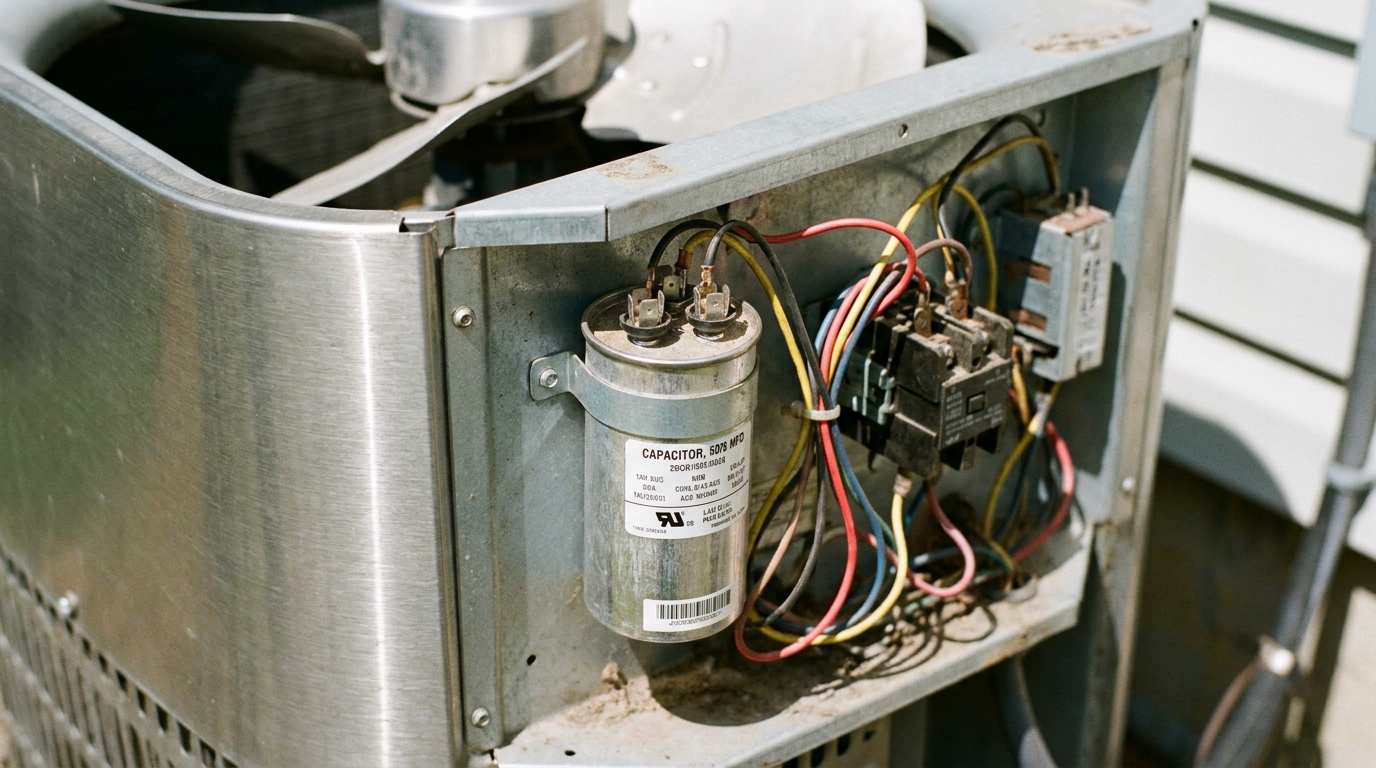
The AC capacitor is the single most common cause of summer breakdowns we see. It's a small cylindrical part — about the size of a soda can — that sits inside your outdoor unit and provides the jolt of electricity that gets your compressor and fan motors moving. When it fails, the system can't start. And in Alabama heat, capacitors fail a lot.
Think of the capacitor as the starter battery for your AC's motors. The compressor and fan motors need a heavy push of current to overcome inertia and start spinning. The capacitor stores that energy and releases it on command. Once the motors are running, the capacitor keeps providing a smaller "running" current to keep them humming.
Most central AC systems use a dual-run capacitor — one part that handles both the compressor and the outdoor fan. When it goes bad, both motors are affected. Sometimes one fails to start while the other limps along. Sometimes neither does. Either way, the system isn't cooling.
Capacitors are rated in microfarads (µF) and voltage. A typical residential unit runs a 35/5 µF or 45/5 µF capacitor at 370V or 440V. The exact rating is printed on the side of the part. We bring this up because the rating matters — installing the wrong capacitor causes new problems instead of fixing old ones.
Heat is the enemy. Capacitors are filled with a dielectric fluid that breaks down faster at high temperatures. An outdoor unit sitting in direct Alabama sun in July is running internal temperatures well above what northern climates ever see. Add humidity and the constant cycling that comes with cooling a house from April through October, and the math works against you.
The other accelerator is voltage spikes. Storms, power-grid blips, and brownouts all stress capacitors. After a bad thunderstorm, capacitor calls spike for two or three days. We've seen it for years. It's not your imagination.
Manufacturer-rated lifespan on residential capacitors is typically 5-10 years. In Alabama, the real number is often closer to 5-7. If yours is the original from a 10-year-old install, it's living on borrowed time.
Here's what the failure usually looks like, in roughly the order most homeowners notice them:
Technically yes. Practically — we'd say no. Here's why.
A capacitor stores electrical energy even after the unit is shut off. We've seen DIY attempts that ended in serious shocks, blown panels, and one very memorable case of a homeowner with eyebrows that didn't grow back evenly. The discharge step matters, the polarity matters, and the µF/voltage rating has to be exactly right. The part costs around $20-$60. A pro replacement runs $150-$300 in the Birmingham area, and it includes verifying that something else didn't damage the new capacitor too.
That said — if you're a DIY homeowner with electrical experience, you know who you are. For everyone else, a capacitor swap is a sub-30-minute job for a tech, and it eliminates the risk of doing it twice.
If you call us for a capacitor: ask whether the tech also tested the contactor (the small black switch right next to the capacitor) and the motor amp draws. Capacitors don't fail in a vacuum. Sometimes a hard-starting motor or a worn contactor takes the capacitor down with it, and a swap-and-go without checking the rest of the circuit means you'll be calling again in three weeks.
Of every service call we run between Memorial Day and Labor Day, capacitors account for somewhere around 30-40% of the total. That's a rough number, but it's been consistent across years. The combination of cheap part, common failure, and predictable summer stress makes it the volume leader by a wide margin.
The good news — when it's caught early, it's also the cheapest summer repair. The bad news — when it fails in a heat wave on a Friday at 6pm, you may be sweating it out till Monday morning. So if your unit is showing any of the seven signs above, the smart move is to call before the system actually quits.
A few things help, in order of importance:
Capacitor failures are predictable, common, and usually easy to fix. They're also the single biggest reason a working AC stops working overnight. If your unit is humming, the fan won't spin, or the system has been slow to start lately, don't wait for the heat to spike. Capacitors don't get better. They only get worse, and they almost always pick the worst possible day to quit.
AC humming, slow to start, or not cooling? Schedule a service call with Tri-Counties Heating & Air. Most capacitor swaps are diagnosed and fixed in a single visit. We serve Birmingham, Homewood, Hoover, Leeds, and the surrounding communities.