Best HVAC Filter for Allergies in 2026: MERV Ratings Explained for Alabama Homes
Walk down the air filter aisle at any hardware store in Birmingham right now and you'll see filters ranging from a $3 fiberglass square that barely catches dog hair to a $40 pleated number that claims to capture viruses. Same physical size. Wildly different prices. Most boxes have a number on them — usually called a MERV rating — that's supposed to tell you which one to pick.
If you're an allergy sufferer in Alabama heading into pollen season, that number actually matters. Pick the wrong one and you're either filtering nothing or you're strangling your AC. Pick the right one and you can pull most of the airborne junk out of your home without a single new piece of equipment.
Here's what MERV actually means, which rating makes sense for an allergy-prone home in Alabama, and where the diminishing returns start.
MERV stands for Minimum Efficiency Reporting Value. It's an industry standard, rated 1 through 20, that measures how effectively a filter captures particles between 0.3 and 10 microns. Higher number = catches smaller stuff.
For residential AC and furnace filters, the practical range is MERV 6 through MERV 16. Anything above MERV 16 is HEPA territory — hospital and lab equipment. Anything below MERV 6 is essentially a screen for keeping bugs out of your blower motor.
Here's roughly what each tier catches:
MERVWhat it catchesTypical use 1-4Big stuff only — dust mites, carpet fibers, pollen larger than 10 micronsCheap fiberglass filters; equipment protection only 5-8Mold spores, dust mite debris, hairspray, cement dustStandard pleated household filters 9-12Auto emissions, lead dust, milled flour, finer pollensRecommended for allergy and asthma households 13-16Bacteria, smoke particles, virus carriers, sneeze dropletsHospital-grade; useful but demanding on residential systems 17-20HEPA territory — viruses, carbon dust, smallest airborne particlesLab and clean-room use; not appropriate for standard HVAC
The interesting bit for allergy sufferers: most allergens fall in the 1-10 micron range. Pollen is 10-100 microns. Mold spores are 1-30 microns. Pet dander is 2.5 microns and up. Dust mite debris sits around 0.5-50. So you don't need MERV 13+ to capture the stuff that's actually making you sneeze. A well-installed MERV 11 catches most of it.
In our experience, the sweet spot for allergy households in central Alabama is MERV 11. That's the rating that:
MERV 11 is also where the American Lung Association and most HVAC manufacturers agree the airflow-vs-filtration trade-off lands best for residential systems. You get a real allergy benefit without overworking the equipment.
For homes with severe allergies, asthma, multiple shedding pets, or a family member with respiratory issues, MERV 13 can be worth the upgrade — but only if the system can handle it. We'll come back to that.
This is the most common mistake we see. Homeowner reads that MERV 16 catches more particles than MERV 8, drops a thick MERV 16 in their system, and three months later we're out replacing a burned blower motor or thawing a frozen coil.
Higher MERV ratings = denser filter media = more resistance to airflow. Your residential AC's blower was sized assuming roughly the same restriction as a MERV 8 or MERV 11 filter. Drop a MERV 16 in there and the blower is fighting through a much thicker wall of pleats to move the same amount of air.
What that looks like in practice:
The right MERV for your home depends on what your blower can actually handle. Some modern variable-speed systems can ramp up to push air through a MERV 13. Standard single-stage systems often can't.
Quick check: Pull your current filter out and look at the back of it. If you see a wavy pattern of darker streaks following the pleats, your filter has been getting pulled hard by the blower. That's a sign your system is straining. Drop down a MERV step or move to a thicker filter media (4 or 5-inch).
A 1-inch filter at MERV 11 has noticeably more airflow resistance than a 4-inch filter at MERV 11. Same filtration class, very different impact on your system.
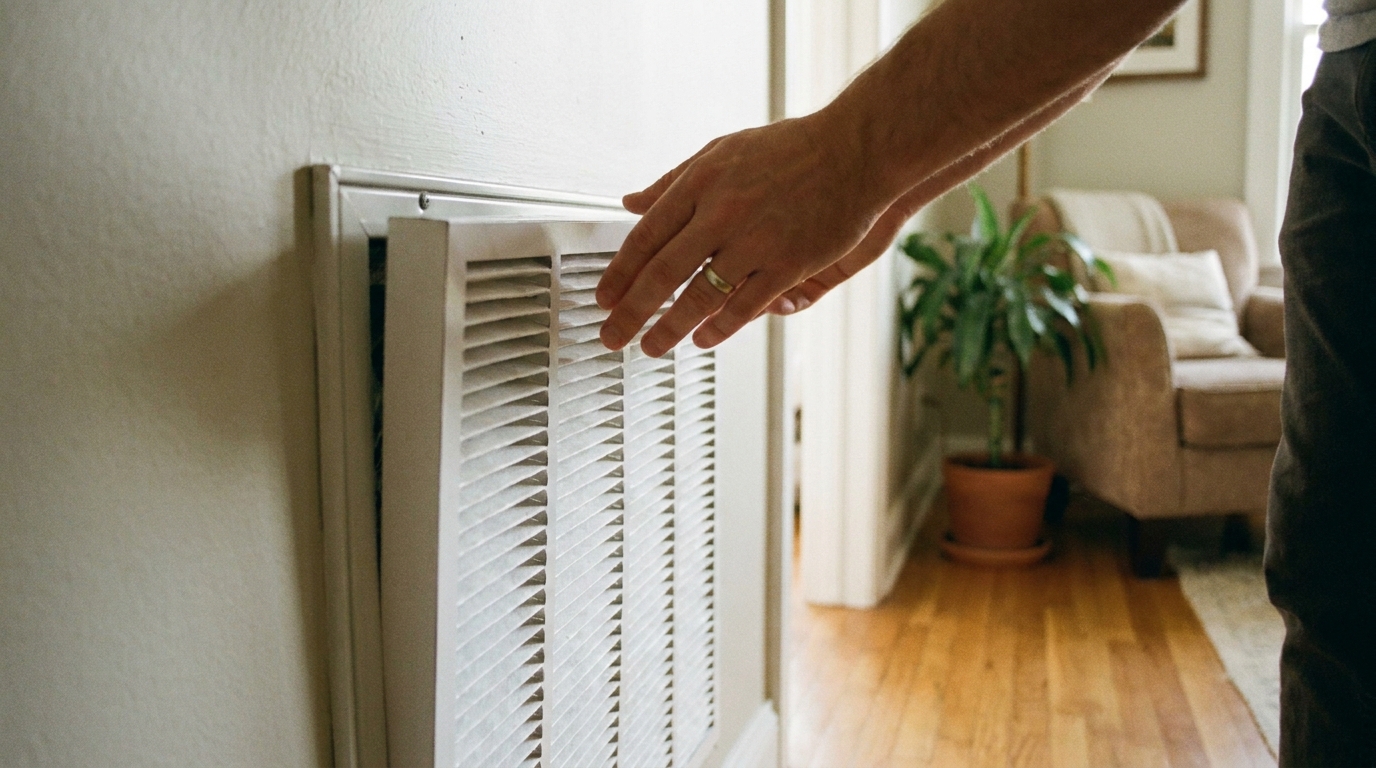
If your filter housing only fits 1-inch filters, MERV 11 is usually your ceiling. If you have a 4-inch or 5-inch housing (sometimes called a "media filter" rack), you can run MERV 13 with less penalty because the larger surface area distributes the pressure drop. Many older Birmingham-area homes only have 1-inch slots in the return air grilles. Newer builds often have a dedicated 4 or 5-inch media cabinet at the air handler.
If you're stuck with a 1-inch slot and you need MERV 13+ filtration for medical reasons, the better solution is usually adding a dedicated air purifier in the bedroom — not forcing a thick filter through a system that can't handle it.
For Alabama homes, the manufacturer-recommended intervals are usually too generous. Our local pollen, red clay dust, and high humidity all load filters faster than the schedule printed on the box assumes.
One trick worth knowing: write the date on the edge of the filter with a Sharpie when you install it. You'll stop second-guessing whether it's been four weeks or four months.
HEPA filters are MERV 17-20 and capture 99.97% of particles down to 0.3 microns. They're amazing at what they do. They're also almost never the right choice for a residential HVAC system, because the pressure drop is so high that most home blowers can't push air through them at all.
If you genuinely need HEPA filtration — somebody in the home is immunocompromised, severe asthma, post-surgical recovery — the right answer is usually a dedicated room HEPA purifier in the bedrooms and living areas, paired with a MERV 11 in the whole-house filter. That gets you the safety of HEPA where people are sitting and sleeping, without strangling your AC.
Walk into Home Depot and you'll see FPR (Filter Performance Rating, Home Depot's proprietary scale). Walk into Lowe's or browse Filtrete and you'll see MPR (Microparticle Performance Rating, 3M's scale). Both are essentially marketing equivalents of MERV that aren't strictly comparable but roughly translate:
If a filter you're considering doesn't list a MERV rating, look for the MPR or FPR and use the translation above. Same product category, different sticker.
Household profileRecommended MERV No allergies, no pets, just want clean airMERV 8 Mild seasonal allergies, one or two petsMERV 11 (1-inch acceptable) Severe allergies, asthma, multiple petsMERV 13 in a 4 or 5-inch cabinet only Immunocompromised household memberMERV 11 + dedicated room HEPA purifier Renovation or post-construction dustMERV 13 temporarily, MERV 11 after System is 12+ years old, variable-speed unknownStick with MERV 8 — old single-stage systems struggle with anything higher
Grass pollen peaks in central Alabama from late May through early July. Tree pollen runs March through May. If you've got the right filter, you'll notice — fewer sneezes indoors, less film of yellow on the dining room table, no more waking up congested when the windows have been closed all night.
If your indoor allergy symptoms aren't dropping when you swap to MERV 11, the problem isn't the filter. It's probably your duct seal (humid Alabama crawlspace air leaking into the ductwork), your envelope (pollen tracking in around doors and windows), or an indoor coil that needs cleaning. A spring tune-up flags all three.
Allergies bad this year? Filter changes only doing so much? Schedule an indoor air quality assessment with Tri-Counties Heating & Air. We'll measure your system's airflow with your current filter, recommend the right MERV for your specific blower, and identify the duct or envelope issues that filters alone won't fix. We serve Birmingham, Homewood, Hoover, Leeds, and the surrounding communities.