Where Is Your Main Water Shut-Off Valve? Find It Before You Need It
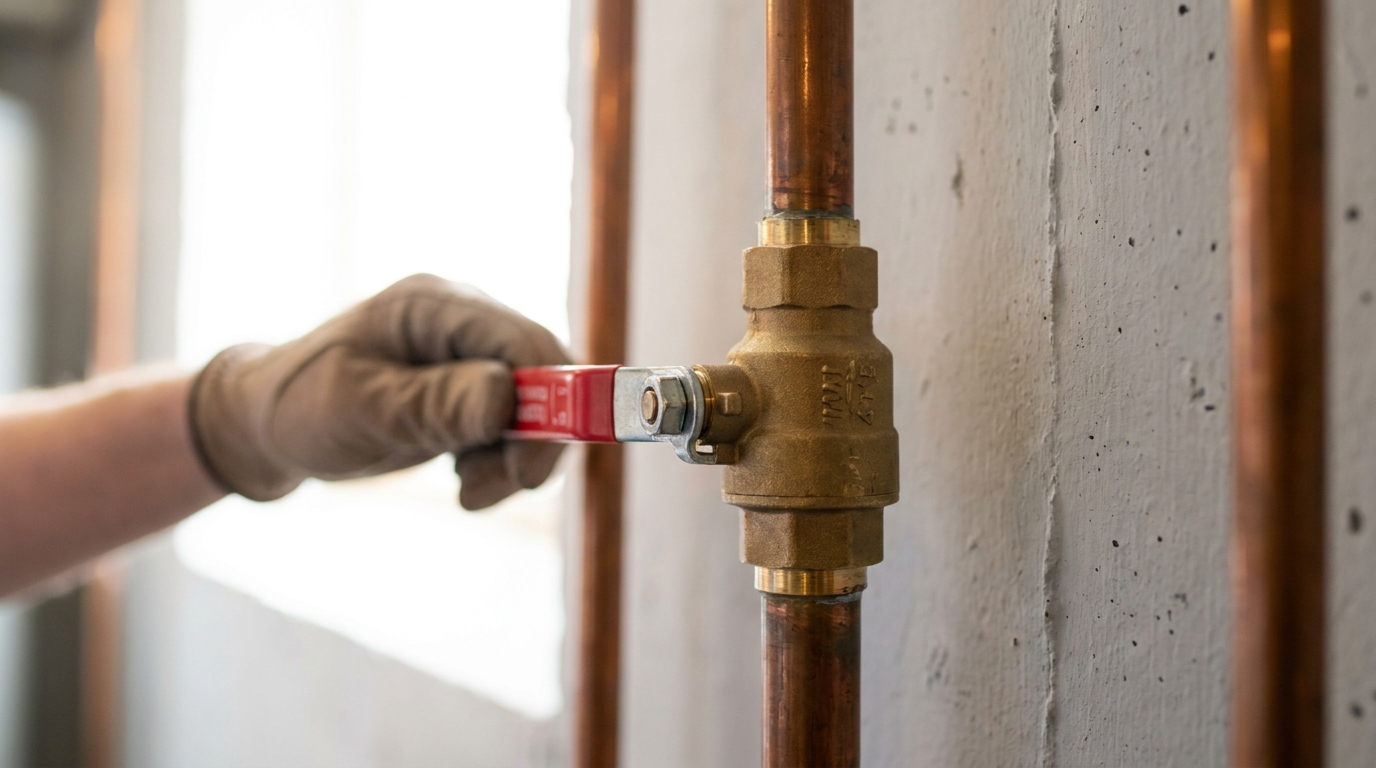

It's 11 p.m. on a Tuesday. The bathroom upstairs sounds wrong — a hissing, then a hard splash. You jog up the stairs and find the supply line under the sink has split, and water is shooting sideways into the cabinet at the pressure of a garden hose. Your phone is in the bedroom. The towels are downstairs. And somewhere in your house, there is a valve that would stop all of this in about three seconds.
Do you know where it is?
Most homeowners don't. We've stood in dozens of houses across central Alabama where the answer was "uh — outside? maybe in the basement?" while water was still flowing somewhere it shouldn't be. The main water shut-off valve is the single most important piece of plumbing knowledge you can have about your own house, and the time to find yours is right now — not the night the bathroom floods.
This is the post that walks through where it likely is, how to turn it, what to do if it's stuck, and why "how to turn off water supply to house" should not be the search query you're running with one hand while standing in an inch of water.
Every home connected to a municipal water supply has at least one main shut-off valve — sometimes two. One sits at the property line where the city's pipe meets yours (the curb stop). The other sits where the water line enters your house. Either one will stop water flow to the entire home. Turn either one to the off position and every faucet, toilet, ice maker, and supply line in the house goes dry within seconds.
That's exactly what you want during a leak. You're not trying to find which fixture is failing. You're trying to make the water stop, right now, everywhere, so you can think.
For most central Alabama homes, the main water shut-off valve is in one of four places. Walk through these in order:
Look for the spot where the main copper or PEX line comes through an exterior wall and enters the house. That entry point usually has a shut-off valve within a few feet on the indoor side. The line is typically 3/4-inch or 1-inch — noticeably thicker than the smaller branch lines feeding individual fixtures.
In Alabama, that entry point is often:
If you can't find the entry-point valve, follow your cold-water inlet line back from the water heater. There's almost always a shut-off close to where the water heater itself is installed, and on many homes it functions as the whole-home shutoff. This is the second-most-common spot in central Alabama.
A lot of older Birmingham-area homes have the main shut-off down in the crawlspace, mounted on the line just inside the foundation wall. This is the worst location — it's exactly where you don't want to crawl in the dark while your kitchen is flooding. If yours is here, consider asking a plumber about adding a more accessible secondary shutoff at a better spot.
Out by the street or sidewalk, you'll see a rectangular metal lid in the ground — usually labeled "WATER" or with the utility name. That's the curb stop. It's technically the city's valve, but you can operate it in an emergency. It requires a special long T-handle key (called a curb key or water meter key). Hardware stores carry them for $15-$30. Worth owning one. Pop the lid, lower the key onto the valve nut, and turn.
Walk your house this weekend. Take 10 minutes, find the valve, show every adult in the household where it is, and put a small label or piece of bright tape on it. Test that you can turn it. Done. You're now ahead of about 80% of homeowners.
You'll see one of two valve types on the main line of an Alabama home:
A short brass or chrome cylinder with a red, blue, or yellow lever handle sticking out of one side. Visually obvious. To shut off, you turn the lever 90 degrees so it's perpendicular to the pipe. To turn back on, rotate it back so the lever sits parallel with the pipe.
Ball valves are the modern standard. They open and close quickly, they don't seize as easily as the old kind, and they last for decades.
A round wheel handle sticking up off the top of a brass body. Looks like a small steering wheel. Turn the wheel clockwise ("righty tighty") to close, counter-clockwise to open. Multiple full rotations — sometimes six or eight — are needed to fully shut off.
The catch with gate valves: they can seize after years of sitting in one position. If yours hasn't been touched in 20 years, it might not turn at all. We'll get to that in a second.
The answer depends on which type you have. Here's the quick reference:
Valve typeOff positionOn position Ball valve (lever handle)Lever perpendicular to the pipeLever parallel to the pipe Gate valve (round wheel)Turn clockwise until it stopsTurn counter-clockwise until it stops Curb stop (street valve)Use a curb key, turn clockwise quarter-turn until perpendicularQuarter-turn back to parallel
The universal rule: "righty tighty, lefty loosey" works for round-wheel valves. Lever valves are easier — if the lever's across the pipe, water's off; if it's running with the pipe, water's on.
This is the second-worst discovery you can make during a flood. Common with older gate valves that haven't been operated in years. Here's what to do, in order:
Never apply heat to a frozen-shut valve. Old brass valves can crack when heated unevenly, and you can rupture the inlet line into your house. That's not a fix — that's a flood times ten.
Here's the exact sequence we tell every homeowner. Memorize it. Run through it in your head some time this week.
Then — and only then — figure out what's leaking and call somebody if it needs a real fix. With the water off, you have all the time you need.
Most fixtures in your house have their own local shutoff. Under each sink, behind each toilet, at the water heater, at the laundry hookups. These are smaller valves you can use without shutting off the whole house.
For a leak at one specific spot, use the local shutoff. It's faster and the rest of the house keeps working. The main shutoff is for when you don't know what's leaking, the leak is somewhere with no local valve (a wall, a hidden pipe, the water heater feed), or the local valve itself is what's failing.
Quick walkthrough since this trips homeowners up. Find the rectangular metal lid in your yard — it'll be near the street or sidewalk and is usually marked "WATER." Lift the lid with a screwdriver or pry bar. You'll see a narrow vertical shaft, sometimes a foot or two deep, with the valve nut at the bottom.
Lower your curb key down the shaft until it seats onto the valve nut. Turn clockwise (looking down from above) a quarter turn. You should feel resistance, then the valve stops. Water is now shut off at the city side.
Pro tip: if your curb stop has never been used, the lid may be stuck shut or filled with dirt. Worth checking on a non-emergency day so you're not finding out in the dark.
If your main shut-off valve is somewhere truly awful — a tight crawlspace, behind a hot water heater, blocked by storage — fix that. Either move stuff, add a secondary shutoff in a better location, or both. We've installed plenty of accessible secondary shutoffs in central Alabama homes, usually in a laundry room or hall closet near the entry-point line, and the install is well under $400. That's a small price for being able to actually reach the valve in two seconds with a flashlight in your other hand.
And honestly, if you walked through this whole post and still don't know where your main valve is — don't wait. Call somebody, have them show you, and label it. The cost of "didn't know where it was" runs into thousands of dollars in subfloor and drywall damage when something fails at 2 a.m. The cost of finding it on a Saturday afternoon is zero.
Not sure where your main water shut-off valve is, or stuck with one that won't turn? Schedule a plumbing assessment with Tri-Counties Heating & Air. We'll locate your main, confirm it actually works, and replace any seized or outdated valves with modern accessible shutoffs. We serve Birmingham, Homewood, Hoover, Leeds, and the surrounding communities.