Whole House Dehumidifiers in Alabama: Do You Actually Need One?
Walk into a Birmingham house in late June and you'll feel it before you can name it. The AC is running. The thermostat reads 73. But the air still feels heavy. Floors a little tacky. Bath towel in the guest room hasn't quite dried since yesterday. That's not a temperature problem. That's a humidity problem — and it's the reason a lot of Alabama homeowners eventually start asking whether a whole house dehumidifier is worth it.
The honest answer is "it depends, but more often than people think." Here's how to figure out if your house is one of the ones that actually needs one, what they cost, what they fix, and where they don't make sense.
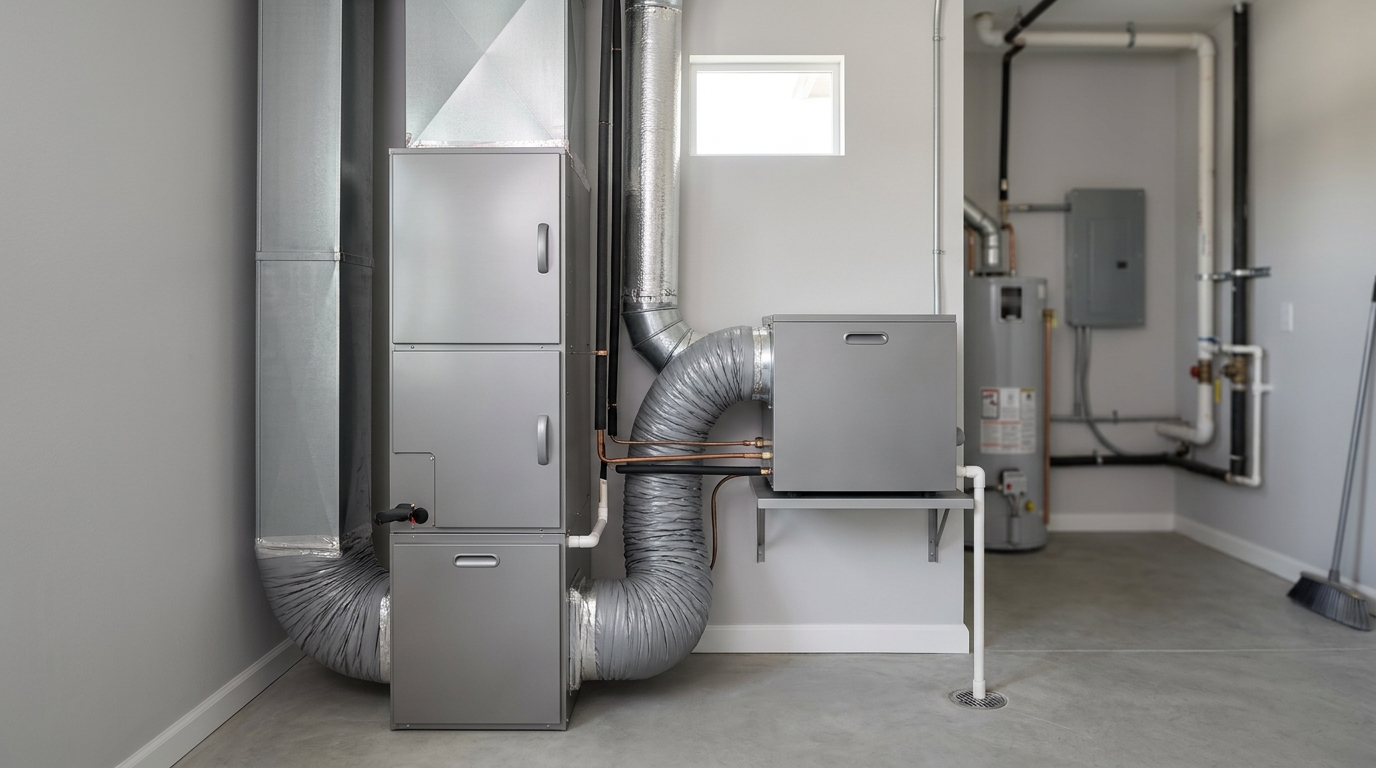
A whole house dehumidifier is a unit that ties into your existing ductwork. It pulls air across a refrigerated coil (similar to your AC's evaporator), condenses moisture out, and returns drier air back into the system. It runs based on a humidity sensor — usually independent of the AC — so it can pull moisture out of the air even when the AC isn't calling for cooling.
That second part is the whole point. Your AC is a temperature machine that happens to remove some moisture as a byproduct. A dehumidifier is a moisture machine first. The two work better together than either does alone.
Most residential units sit in the attic, basement, or crawlspace. They're hard-wired to a dedicated drain line, and they run a lot quieter than people expect. You generally won't hear it from the living space.
This is the part most people don't realize until we explain it on a service call. Your air conditioner only removes humidity while it's running. Once it hits the thermostat setpoint and shuts off, no more moisture removal happens. In a normal climate that's fine. In central Alabama? It's the source of half the comfort complaints we hear.
Here's a typical scenario. It's 78°F outside and 80% humidity — a classic spring or fall day in Birmingham. Your AC was set to 73, the temperature inside hits 73 quickly, and the system shuts off. Outside humidity infiltrates the house. Indoor relative humidity climbs to 60% or 65%. The thermostat doesn't care because it's only watching temperature. You feel sticky and uncomfortable, but the AC isn't going to come back on for another hour.
This is exactly the gap a whole house dehumidifier fills. It runs based on humidity, not temperature. Indoor RH rises above your setpoint (typically 50%), the dehumidifier kicks on regardless of what the AC is doing, and it pulls moisture until the air dries out.
You don't need a dehumidifier just because you live in the South. Plenty of Alabama homes do fine with a properly sized, well-maintained AC. But if you're seeing more than two or three of these in your house, it's worth a conversation:
Indoor relative humidity above 55% consistently is the threshold where most building materials and human comfort start to suffer. A $20 hygrometer from the hardware store will tell you in 30 seconds whether you're over the line.
The comfort improvement is the obvious one, and most homeowners who install a whole house dehumidifier notice it the first day. But there are a few less obvious wins too.
Lower cooling bills. This sounds backwards — add another piece of equipment, save money? But humid air feels warmer than dry air at the same temperature. If indoor RH drops from 60% to 45%, most people are comfortable at a thermostat setting two or three degrees higher. Your AC runs less. Real-world savings vary, but a 10-15% reduction in summer cooling cost is common.
Less wear on your AC. An overworked AC trying to handle both temperature and humidity in Alabama summers runs more total hours per year. Pull the humidity load off it and you're shortening its annual runtime. That extends compressor life, which is the most expensive component to replace.
Mold and material protection. Mold needs moisture to grow. Wood floors warp from moisture. Drywall absorbs and releases moisture. A house held consistently between 40% and 50% RH year-round is a more durable house. We've replaced trim and refinished floors for homeowners who didn't catch the humidity problem until the damage was visible.
Healthier indoor air. Dust mites, mold spores, and several common allergens all thrive in higher humidity. Drying the indoor air out is one of the most effective indoor air quality moves you can make.
Quick reference: 30-50% relative humidity is the sweet spot for an Alabama home. Below 30% and your skin and wood furniture suffer in winter. Above 55% and you're inviting mold, dust mites, and discomfort.
Equipment plus installation in central Alabama generally runs $2,000 to $3,500 for a typical home, depending on a few factors:
For a 2,000 sq ft Birmingham home with an existing AC and accessible ductwork, expect to be in the $2,500-$3,000 range for parts and labor on a quality unit. Cheaper installs exist, but the economics on this equipment favor buying once — these things last 10-15 years if you stay on top of filter changes.
We try to be honest about this part. A whole house dehumidifier isn't the right call for everyone.
If your indoor humidity is already in the 40-50% range during a typical Alabama summer, your existing system is doing its job. Adding a dehumidifier won't move the needle. Spend the money elsewhere.
If your humidity problem is concentrated in one room — a single bathroom, a workshop, a sunroom — a portable unit or a localized exhaust fan is going to be more cost-effective than a whole-house solution.
If your AC is undersized for the home, install a properly sized AC first. An oversized AC short-cycles and never runs long enough to dehumidify; an undersized one runs forever and still can't keep up. Either of those problems should get fixed before adding a dehumidifier on top of a system that doesn't fit the house.
And if you've got a serious crawlspace moisture problem — standing water, missing vapor barrier, foundation drainage issues — the dehumidifier is treating the symptom. Fix the source first.
An undersized dehumidifier runs constantly and never quite catches up. An oversized one cycles too quickly and doesn't run long enough to dry the air efficiently. Like AC sizing, this is something a professional load calculation should handle, not a guess.
The general rule for Alabama homes:
If a contractor quotes a unit without asking about your square footage, attic ductwork, or crawlspace situation, that's a red flag.
One of the better things about these units is that they don't ask much. Filter changes once or twice a year, depending on filter type. A periodic check on the condensate drain to make sure it's flowing. An annual visual inspection during a regular HVAC tune-up.
Most modern units have built-in alerts if the filter is dirty or the drain is blocked. If you're already on a maintenance plan with us, the dehumidifier just gets folded into the same visit. No additional service appointments needed.
A whole house dehumidifier isn't a luxury or an upsell in Alabama. For homes that genuinely struggle with summer humidity — and a real chunk of homes in the Birmingham area do — it's one of the highest-impact comfort upgrades available. The energy savings, equipment longevity, and material protection often pay back the install within five to seven years. The comfort improvement shows up the first weekend.
For homes whose existing AC is already keeping humidity in check, save your money. The right answer depends on what your house is actually doing, not what the brochure says.
Not sure if your house actually needs one? Schedule a humidity assessment with Tri-Counties Heating & Air. We'll measure indoor RH across your home, look at your current system, and give you an honest answer — not a sales pitch. We serve Birmingham, Homewood, Hoover, Leeds, and the surrounding communities.