How Long Do Air Conditioners Last? A Repair-vs-Replace Guide for Alabama Homeowners
It's the question every homeowner asks eventually, usually while standing over a unit that just cost them a repair bill: how much longer is this thing supposed to last? You're not trying to squeeze a miracle out of it. You just want to know whether you're throwing good money after bad, or whether one more fix buys you a few more good summers.
So let's answer it plainly. How long do air conditioners last? In central Alabama, a well-maintained central AC runs about 12 to 15 years. Some limp to 20 with luck and care; plenty of neglected ones tap out at 10. But the number on the calendar is only half the story — the real decision is repair versus replace, and that comes down to a few specific things you can actually check.
Here's what different pieces of your system tend to last, assuming reasonable maintenance:
System typeTypical lifespan Central air conditioner (condenser)12–15 years Heat pump (runs year-round)10–15 years Furnace / air handler15–20 years Ductwork20–30 years
Notice the AC and the furnace don't age at the same rate. That matters, because a system replaced all at once stays matched — and a matched system runs at its rated efficiency. It's common to replace the AC while a newer furnace still has life, and that's fine, as long as whoever does it confirms the two will actually work together.
Those national lifespan numbers assume an average climate. Ours isn't average. We run our systems from April clear through October — roughly twice the annual runtime of a home up north — under high heat and brutal humidity. More runtime means more wear on every moving part, and our humidity keeps coils and drain lines working overtime.
The practical upshot: down here, the difference between a system that dies at 10 and one that lasts 16 is almost entirely maintenance. A unit that gets an annual tune-up and a clean filter ages slowly. One that's never touched ages fast. That's not a sales line — it's just what the runtime does.
Age alone rarely settles it. Watch for these, and pay attention when two or three show up together:
Here's the rule of thumb that actually works. Multiply the age of the unit by the cost of the repair in front of you. If the result clears about $5,000, replacement is usually the smarter buy.
A 13-year-old unit needing a $450 fan motor: 13 × 450 = 5,850. Over the line — lean replace. A 6-year-old unit needing the same $450 repair: 6 × 450 = 2,700. Fix it and move on. It's a napkin calculation, not gospel, but it captures the real dynamic: a cheap repair on a young system is fine; an expensive repair on an old one is money you won't get back.
The compressor exception: if the compressor fails on a unit that's out of warranty, that's almost always a replace, regardless of the math above. It's the single most expensive part, and replacing it on an aging system usually means sinking a large repair into a unit that's going to need replacing soon anyway.
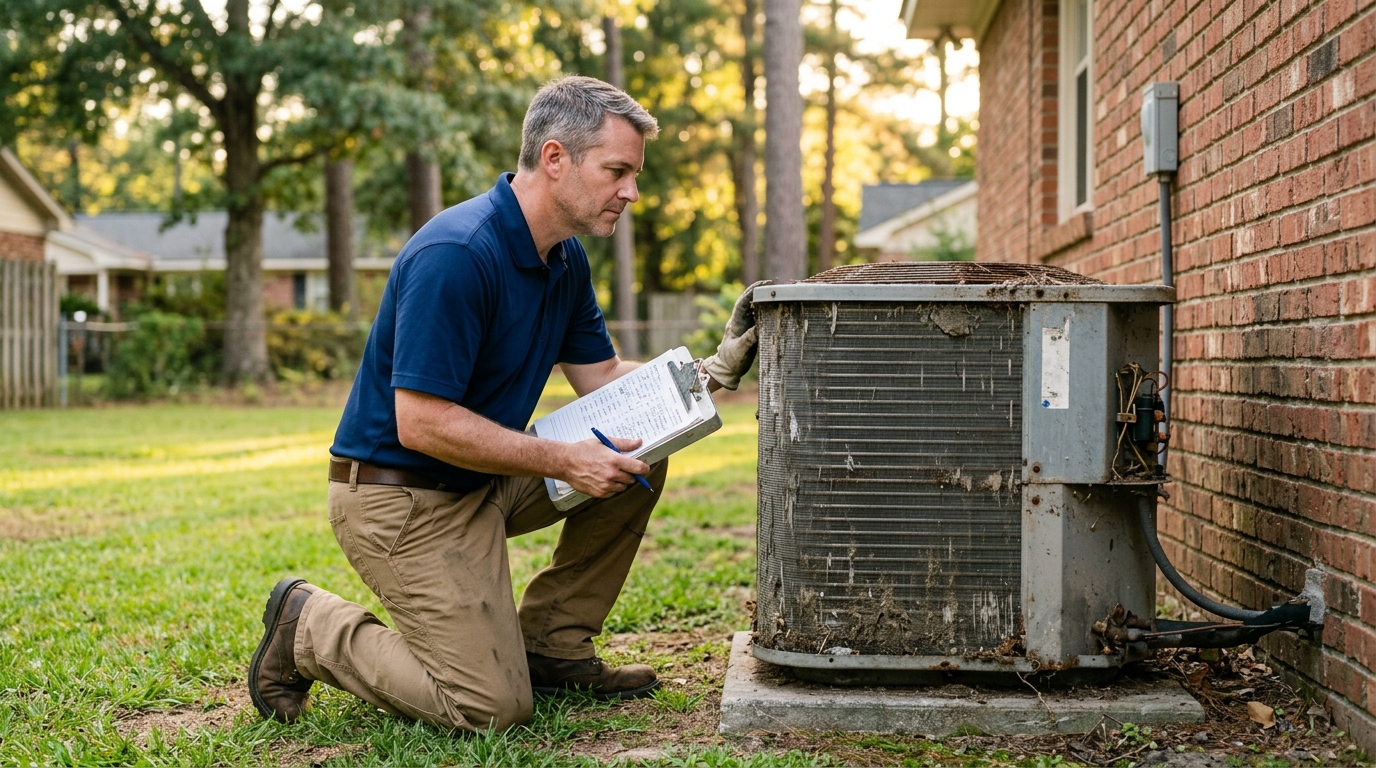
Replacement isn't always the answer, and any company that jumps straight to "you need a new system" on a young unit should give you pause. Repair makes sense when the system is under about 10 years old, the fix is a common wear item — a capacitor, a contactor, a fan motor, a clogged drain — and it's the first real trouble you've had. Plenty of "I think I need a new AC" calls turn out to be a couple-hundred-dollar fix. If you're not sure what you're looking at, our breakdown of a clogged AC drain line covers one of the most common culprits that masquerades as a dying system.
When the math does point to replacement, you're not just buying "working" again. A new system means a fresh warranty, meaningfully better efficiency (which shows up on every summer bill), quieter operation, and proper humidity control sized to your home. It's also the moment to fix whatever was wrong with the original install — sizing, duct connections, line set — that a straight box-for-box swap would just carry forward. For what a replacement runs in 2026, we laid out honest local pricing in our guide on how much a new AC unit costs.
Don't let a July breakdown make the call for you. The worst time to buy a system is the afternoon the old one dies in a heat wave — hot, stressed, and taking whatever's available fastest. If yours is 12+ years old and showing a couple of these signs, get the assessment done now, on your terms, with time to compare options and sizing.
Whether you're nursing an older unit or protecting a new one, the same short list adds years: change the filter every one to two months, keep the outdoor unit clear of leaves and weeds, flush the condensate drain each season, and get a professional tune-up once a year. None of it is expensive. All of it slows the wear that our long cooling season piles on.
Plan on 12 to 15 years from a central AC in Alabama, knowing maintenance is what pushes you toward the high end. When something breaks, run the age-times-cost math, weigh it against the warning signs, and treat a failed compressor or an R-22 recharge as a replace. One symptom on its own usually isn't the end — but when age, rising bills, and a real repair line up together, that's the system telling you it's time.
Not sure whether to repair or replace your AC in Birmingham, Homewood, Hoover, or Leeds? Schedule a no-pressure assessment with Tri-Counties Heating & Air. We'll tell you honestly how much life is left, run the repair-vs-replace math with you, and — if it's time — size the new system to your actual home. Serving Birmingham, Homewood, Hoover, Leeds, and the surrounding communities.