How to Tell If Your Thermostat Is Bad (or If It's the System)
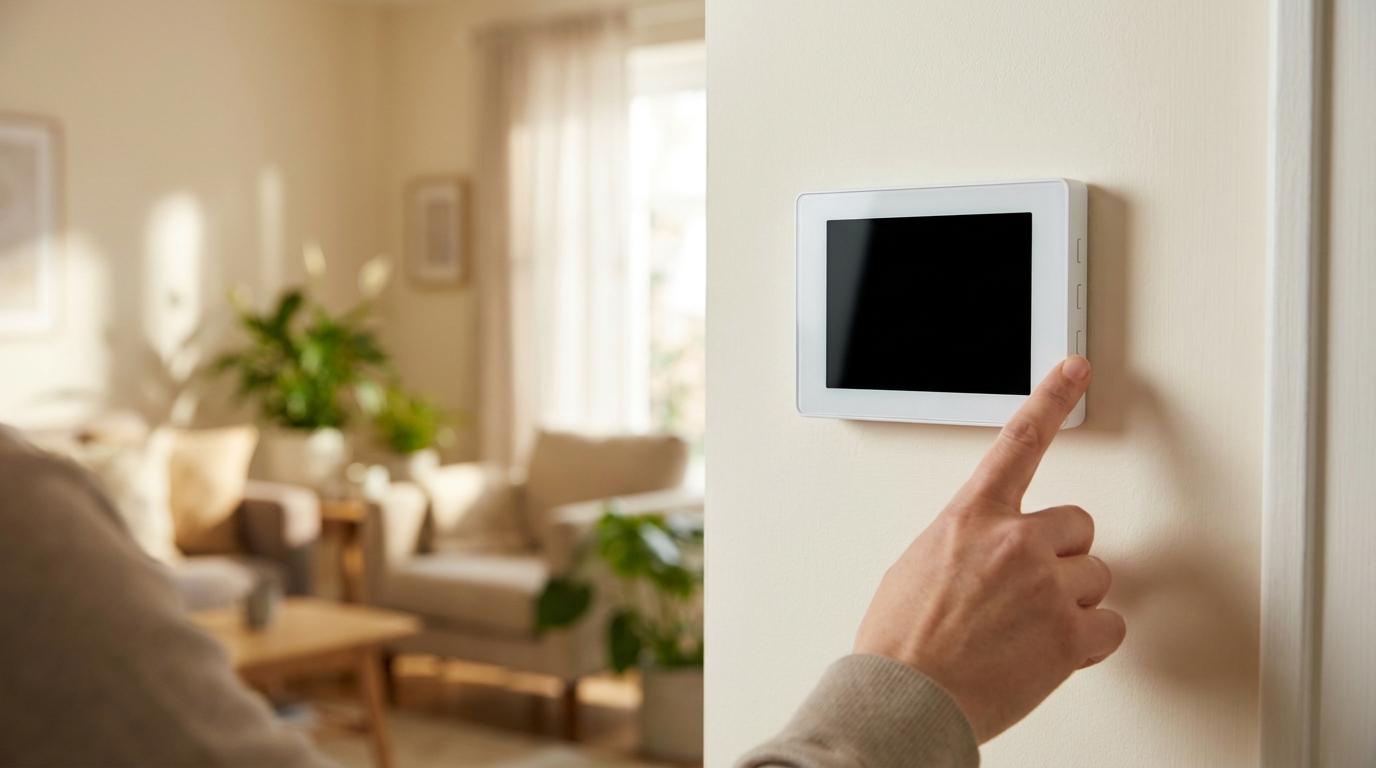

Here's a call we get a lot, and it always sounds the same. The house isn't heating, or isn't cooling, and the homeowner is standing in the hallway staring at a thermostat that looks fine. Display's on. Numbers look right. Nothing is obviously broken. And yet nothing is happening.
The frustrating thing about a bad thermostat is that it looks exactly like a bad HVAC system from where you're standing. Same symptom, wildly different repair bill. So before you call anybody — including us — there are a few checks worth running, because a decent share of these turn out to be a two-dollar fix.
It helps to know what you're dealing with. Your thermostat isn't a heater or an air conditioner. It's a switch. A fairly dumb one, honestly. It reads the room temperature, compares it to what you asked for, and closes a low-voltage circuit that tells the equipment in your attic or closet to start running.
That's it. Which means when a thermostat fails, it fails in one of two directions: it stops telling the system to run, or it tells the system to run at the wrong times. Everything below is a variation on those two themes.
Do these before assuming anything. In our experience, close to half of "my thermostat is dead" calls end here.
Still nothing? Now it's worth suspecting the thermostat itself.
There's a diagnostic that separates "bad thermostat" from "bad system" pretty definitively, and a technician will do it in about ninety seconds. With power off at the breaker, the thermostat is pulled off the wall and two terminals on the base are bridged — R to W for heat, R to Y for cooling — which bypasses the thermostat entirely and signals the equipment directly.
If the system fires up with the thermostat bypassed, the equipment is fine and the thermostat is the failure. If nothing happens, the thermostat was never the problem and we start looking at the board, the transformer, the wiring, or the equipment itself.
We're describing it so you know what your tech is doing and why, not as a weekend project. It involves live low-voltage wiring and it's easy to short something and take out a control board — which turns a $150 thermostat swap into a much larger repair. If you're not certain, don't.
Some symptoms get blamed on the thermostat that almost never trace back to it.
If the system starts and then stops on its own after running a while, that's usually an equipment problem — a tripped limit switch, a dirty flame sensor, a frozen coil. If the outdoor unit hums but the fan doesn't spin, that's very likely a capacitor, which is the single most common summer failure we see and something we covered in detail in our post on the seven signs of AC capacitor failure. And if certain rooms are uncomfortable while the thermostat's room is perfect, the thermostat is reporting accurately — you've got a duct or airflow problem instead.
A lot of homes around here have systems old enough that the original thermostat ran on batteries and four wires. Smart thermostats generally want a fifth — the C-wire, or common wire — to draw continuous power.
When a smart thermostat gets installed without one, it tries to steal power by pulsing the heating or cooling circuit, and the result is a thermostat that behaves erratically for reasons that have nothing to do with a defect. Random reboots. Short cycling. Wi-Fi that keeps dropping. If your problems started right after a smart thermostat went in, that's the first thing to check, and it's a fixable one. If you're already running a smart unit successfully, there's real money in using it well — see setting up smart thermostat schedules before you travel.
Thermostats are among the cheaper things that can go wrong. A basic programmable unit installed typically lands in the low hundreds; a smart thermostat with a C-wire run costs more, mostly in labor if new wire has to be pulled. Either way it's an order of magnitude below a control board or a compressor.
Which is the good news buried in all of this. If your thermostat really is the problem, you got lucky.
Check the batteries, the breaker, and the furnace door before anything else — that's most of them. Watch for the seven signs above. And if the system responds when the thermostat is bypassed, you've found it. Most of these get diagnosed and fixed in one visit, and heading into fall is a sensible time to catch it, because a thermostat that's marginal in September becomes a no-heat call in December. Our fall tune-up checklist covers what else is worth looking at before the first cold snap.
Thermostat blank, unresponsive, or reading the wrong temperature? Schedule a diagnostic with Tri-Counties Heating & Air. We'll determine whether it's the thermostat or the system before anything gets replaced. We serve Birmingham, Homewood, Hoover, Leeds, and the surrounding communities.