What Size AC Do I Need? Tonnage, Manual J, and Why Bigger Is Worse
You're getting quotes for a new system, and the numbers on the proposals don't match. One contractor says three tons. The next says four, and mentions — with a little grin — that he'd go bigger because "you'll want the extra on those 98-degree days." That sounds like the safer choice. More cooling, more better, right?
It isn't. Oversizing is one of the most common and most expensive mistakes in residential HVAC, and in a humid climate like ours it produces a house that's cold and clammy at the same time. So here's how to answer what size AC do I need honestly: how tonnage actually gets calculated, why the square-footage rule you'll find online is a rough guess at best, and why the bigger unit is usually the worse buy.
A ton of cooling isn't a weight. It's a rate — 12,000 BTUs of heat removed per hour, a number that dates back to how much cooling you'd get from a ton of ice melting over a day. Residential systems in Alabama typically run from 1.5 to 5 tons, in half-ton steps.
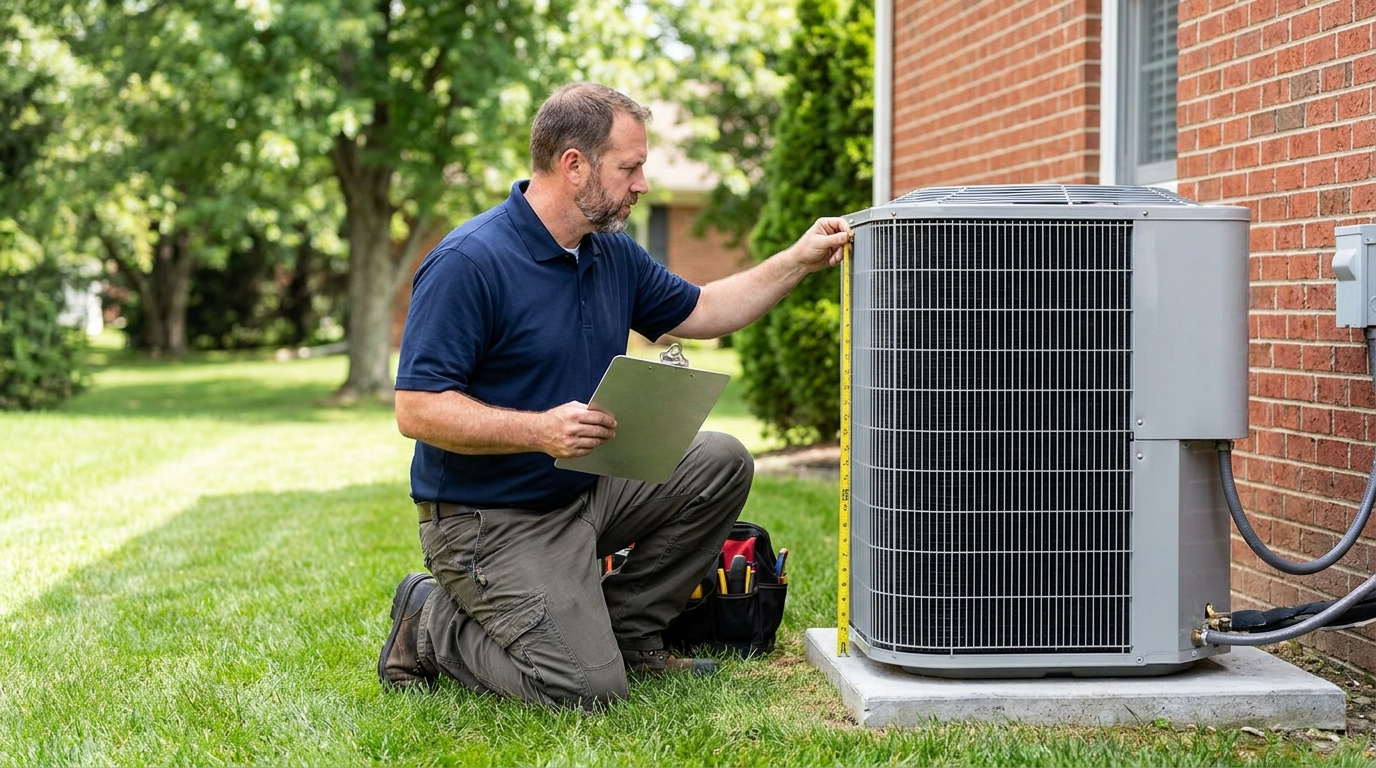
If you want to know what you have now, you don't need a tech for it. Find the model number on the data plate of your outdoor condenser and look for a two- or three-digit number in the string — usually 18, 24, 30, 36, 42, 48, or 60. That's BTUs in hundreds. So 36 means 36,000 BTU, which is three tons. It's the quickest way to tell the tonnage of an AC unit, and it's worth knowing before anyone quotes you a replacement.
Knowing your current size is useful, but it isn't the answer. Plenty of Alabama homes are running equipment that was oversized when it was installed twenty years ago, and "match what's there" just repeats somebody else's mistake. It's a data point, not a specification.
Search for an AC tonnage calculator and you'll land on some version of the same rule of thumb: one ton per 500 to 600 square feet. In our climate most quick charts land closer to 500.
Home sizeRough starting point 1,000 sq ft2 tons 1,500 sq ft2.5–3 tons 2,000 sq ft3.5–4 tons 2,500 sq ft4–5 tons 3,000 sq ft5 tons (or two systems)
Use that to sanity-check a quote. Don't use it to buy equipment. Square footage ignores almost everything that actually determines how much heat gets into your house, and two 2,000-square-foot homes on the same street can genuinely need different systems. What the rule leaves out:
The industry standard is a Manual J load calculation — a room-by-room heat gain and heat loss calculation published by ACCA. A tech measures the house, records window sizes and orientations, checks insulation levels and duct condition, factors in local design temperatures, and comes out with a BTU number for the actual building rather than a category it loosely belongs to.
It takes real time to do properly. Which is exactly why a lot of companies don't — it's much faster to look at the old unit, look at the square footage, and write down a number. A contractor who runs a Manual J is telling you something about how they work before you've spent a dollar.
And the results surprise people. It's common for a load calculation to come back smaller than the system currently sitting in the yard. That's not the calculation being wrong. That's usually the last install being generous.
Here's the mechanism, and once you see it you can't unsee it.
An oversized AC cools the air fast. It hits the thermostat setpoint quickly, shuts off, and sits idle until the temperature drifts back up — then blasts on again. Short bursts, over and over. That's short cycling, and it causes three separate problems.
First, humidity. Your AC removes moisture only while it's running, and dehumidification takes sustained runtime — moisture has to condense on a cold coil and drain away, and that process is slow to get going. A system that runs in seven-minute bursts never gets there. The air hits 73°F and the machine stops, satisfied, while the house sits at 65% humidity feeling swampy. That's the classic oversized-system complaint, and it's why we spend so much time on humidity control down here. People with oversized units keep lowering the thermostat chasing a comfort that a drier house would have given them three degrees warmer.
Second, wear. Startup is the hardest thing a compressor does — the moment of highest electrical draw and mechanical stress. A system that starts six times an hour instead of twice ages accordingly. Capacitors and contactors fail early on short-cycling systems, and we see it often enough that capacitor failure is our most common summer repair. Shorter equipment life, more service calls.
Third, comfort and cost. Short cycles mean uneven temperatures room to room, more noise, and worse efficiency, since a system burns the most power in the first minutes of a cycle and is at its most efficient in a long steady run.
Undersizing isn't the safe alternative either. A unit too small for the house runs continuously on the hottest days and still can't hold the setpoint, which wears it out from the other direction and leaves you uncomfortable in August. The goal isn't "err smaller." It's right-sized — a system that runs long, steady cycles on a design-temperature day and cycles gently the rest of the time.
You don't need to become an HVAC engineer to protect yourself. Three questions do most of the work:
What size AC do you need? Whatever a proper load calculation says — which is frequently a half-ton less than the unit you're replacing, and almost never more than the square-footage chart suggests. Bigger doesn't mean cooler. In Alabama it usually means clammy, noisy, and shorter-lived. Ask for the Manual J, ask about the ducts, and be a little suspicious of anyone who sizes your system from the driveway.
Getting quotes for a new system in Birmingham, Homewood, Hoover, or Leeds? Schedule a load calculation with Tri-Counties Heating & Air. We'll measure the house, check the ductwork, and give you a size we can show our work on — not a number pulled off the old unit.